How Hong Kong Manages to Stay Fashionable
Forget the binary of East and West. Hong Kong fashion was never waiting for permission.
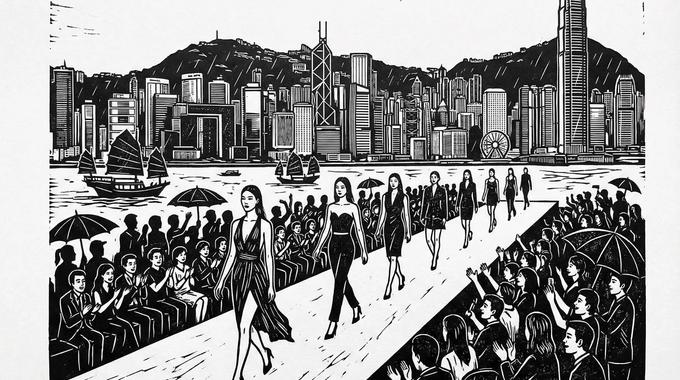
Hong Kong has never been a city that asks permission to be taken seriously. It simply gets on with it — and in fashion, that quality has produced something genuinely interesting: a scene that refuses the binary of East versus West and builds something from the collision instead.
The evidence is accumulating. In February 2026, the Hong Kong Trade Development Council brought four designers to London Fashion Week at The Vinyl Factory in Soho, drawing over 300 international buyers and landing coverage in Dazed, BBC News, Forbes, and Vogue Business. The four — Angus Tsui, Bettie Jiang, Harrison Wong, and Menu Tsai — offered a portrait of the city's range that no single aesthetic could contain. Tsui's collection, titled 404: Safety Not Found, channelled Hellraiser through a meditation on self-doubt, with sharp cinematic tailoring that drew comparisons to Rick Owens. Bettie Jiang — praised by Alexander McQueen himself during her time at his label — brought zero-waste pattern cutting to the runway with the kind of discipline that makes sustainability feel like a creative constraint rather than a PR gesture. Harrison Wong sent out suits embroidered to resemble snowfall. Menu Tsai deconstructed football jerseys into high couture, integrating panels from balls used by famous players and pleating Scotland's colours into garments that said more about cultural identity than any flag could.
The range matters. What London saw was not a unified Hong Kong aesthetic — it was proof that the city produces distinct creative voices, not a house style.
The scene behind the runway is equally compelling. Caroline Hú, a Central Saint Martins graduate whose brand Reverie has become one of the most discussed womenswear labels emerging from the city, has been cited by Business of Fashion as central to Hong Kong's case as a genuine design hub. Her work reads, in the SCMP's description, like an emotional diary — couture romance that is as interested in feeling as in construction. Derek Chan's label Demo takes classical menswear codes and disrupts them with unexpected proportions and embellishment, creating what the same paper called a gender-fluid vocabulary of what men are allowed to be. Kit Wan makes stagewear through a sci-fi lens — his pieces have appeared at the Grammys — while Max Tsang builds clothing as hardware: futurist, agender, and entirely wearable.
Then there is the generation coming up behind them. Kinyan Lam has been named a semi-finalist for the 2026 LVMH Prize, with a practice rooted in Dong cloth — a naturally dyed fabric from Guizhou — and collaboration with local craftswomen whose techniques might otherwise disappear. Tiger Chung Tsz Ho won the 2024 Hong Kong Young Fashion Designers' Contest with a collection that fused haute couture craftsmanship with festival culture and deliberate surrealism. His co-founder at Tigers Trolling, Tiger Chung Ka Ching, took both the global and Hong Kong titles at the Redress Design Award, building subversive pieces from fan covers, plastic bags, and materials fashion would rather pretend don't exist. Jasmine Cheuk's Fab.flow, built around circular denim, was a finalist in last year's YDC and is now targeting the Global Denim Talent Programme.
The structural reason Hong Kong keeps producing this work is not mysterious. The city sits at the intersection of world-class design education — Hong Kong Polytechnic University, the Hong Kong Design Institute — and a trade infrastructure that has spent decades connecting Asian manufacturing with global retail. That combination means designers here understand both the craft and the commerce, the atelier and the supply chain, in ways that purely art-school ecosystems often don't.
What has changed in recent years is the confidence. For a long time Hong Kong fashion operated under the assumption that the interesting work happened elsewhere — in Paris, London, New York — and that the city's role was commercial rather than creative. That assumption is being retired, season by season, by designers who are not interested in waiting for permission from the traditional centres. Robert Wun — Hong Kong-born, London-based — has built a cult following for cinematic sculptural pieces that have become a fixture on red carpets and in major editorials. His couture debut in Paris was received with near-universal praise. He is not the exception. He is the signal.