Is the Latest 'Salvator Mundi' Real?
The $450 million Leonardo is locked in a palace and hasn't been seen since 2017. A better one just went on sale.
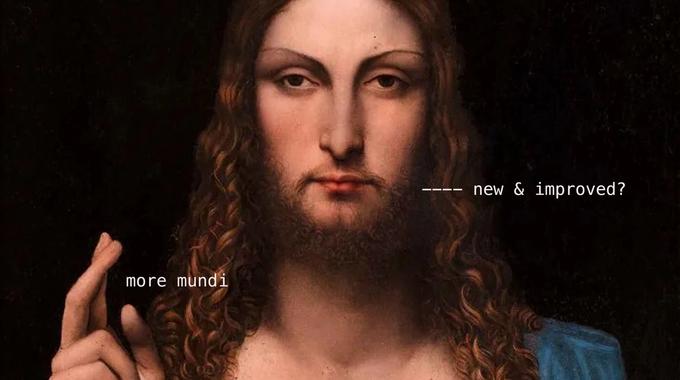
Good hook — there's real news here. The de Ganay Salvator Mundi just surfaced at TEFAF Maastricht this month. Here's the essay.
Another Saviour of the World has appeared. This one arrived at TEFAF Maastricht last week, presented by London's Agnews Gallery on a walnut panel, dated between 1505 and 1515, and described in the accompanying documentation as the work of "a faithful pupil of the master, doubtless painted under his supervision and with his possible intervention." No price was attached to it. There are, as Agnews noted, no real comparables.
The painting is known as the de Ganay version, after the French marquess family with whom it resided for much of the twentieth century. It is one of roughly twenty known versions of the Salvator Mundi composition — Christ in Renaissance dress, orb in hand, blessing the viewer — most of which issued from Leonardo da Vinci’s workshop in Milan around the turn of the sixteenth century. The question that has animated the art world, on and off, for the past decade is which one, if any, was actually by Leonardo himself. The answer has kept shifting.
The Cook version is the one that sold at Christie's in 2017 for $450.3 million, making it the most expensive painting ever sold at auction. It had been acquired from an American estate in 2005 for considerably less, restored over six years, and consensually attributed to Leonardo by a group of scholars in 2011. Christie's sold it in a contemporary art sale, which insiders found appropriate given estimates of how much of the surface had been added in the last fifty years. Mohammed bin Salman bought it. The Louvre Abu Dhabi announced it would display it. It has not been seen in public since.
In 2022, the Prado's Leonardo specialist formally downgraded the Cook version to the category of works "attributed to, workshop of, or authorised and supervised by Leonardo." In the same paper, she suggested that the de Ganay painting might actually be closer to the lost original. The Louvre had already gestured in this direction: it included the de Ganay version in its 2019 Leonardo retrospective. The Cook canvas was not invited.
What Agnews is selling, then, is not quite a Leonardo. It is something stranger and arguably more interesting: the version that the market passed over, now repositioned as the version the scholars prefer — at a moment when the $450 million one is locked in a palace somewhere and cannot be examined by anyone. The orb, as ever, remains.