The one-person software company is now real — and it changes everything.
Vibe coding, OpenClaw, and three founders who proved that one person with the right tools can now build what used to take a team.
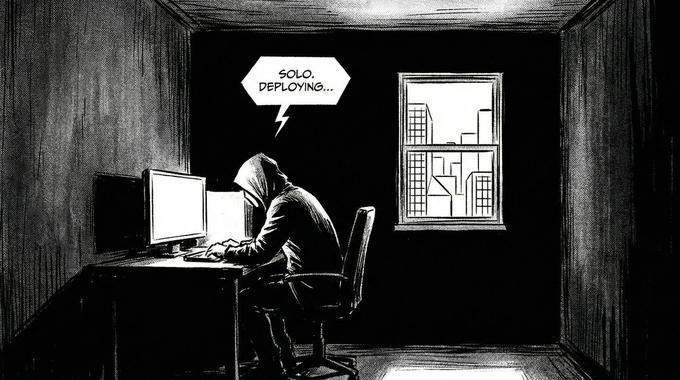
There is a phrase Andrej Karpathy (@karpathy on X) put into circulation in early 2025 — vibe coding — that the industry initially treated as a joke. Describe what you want in plain language, let the AI write the code, accept the output, iterate. Don't worry about understanding what's underneath. The joke, it turned out, was on anyone who didn't take it seriously.
By early 2026, the evidence was in. Peter Steinberger (@steipete on X), a former iOS developer who had sold his company for a reported €100 million and retired, came back from retirement bored, built an agentic AI assistant in his spare time, named it after a lobster, and watched it accumulate 247,000 GitHub stars and 47,700 forks before he had even decided what to do with it. OpenClaw became the fastest-growing open-source project on the internet. Steinberger was coding alone, shipping constantly, iterating in public. Jensen Huang mentioned him at GTC. Sam Altman hired him. The lobster took over the world, as Steinberger put it, with characteristic understatement.
This is not a story about one person getting lucky. It is a story about a structural change in what software development costs, and who can do it.
Pieter Levels (@levelsio on X) saw this coming before almost anyone. He has been building and shipping products alone — no co-founder, no team, no investors — since 2014. His portfolio now generates approximately $3 million a year. The model he proved was simple: find a real problem, build the smallest possible solution, ship it, see if anyone pays. The constraint was always time. One person can only build so much. What AI coding tools have done is remove that constraint. Levels was doing this when it was hard. The point he has made repeatedly is that it is now easy enough for almost anyone.
Tony Dinh (@tdinh_me on X) is the proof. A software engineer from Vietnam, he quit his job, built in public, failed several times publicly, and eventually hit $83,000 in monthly recurring revenue running products entirely by himself. His most successful product, Typing Mind, launched within hours of ChatGPT going public and has continued to compound. He does the coding, the design, the marketing, the customer support, and the iteration. He is not a genius. He is organised, fast, and willing to ship something imperfect and fix it later. That combination, which used to require a team, now fits in one person's working day.
The question this raises is not whether the solo founder model works. It clearly does. The question is what happens to the software industry when the cost of starting a software company approaches zero and the primary constraint becomes distribution rather than development. Venture capital funds teams, not individuals. It assumes that building is the hard part and that scale requires headcount. Neither of those assumptions is as reliable as they were two years ago. Custom ASIC shipments from cloud providers are projected to grow at nearly three times the rate of GPU shipments in 2026 — a sign that even at the infrastructure level, specialisation and efficiency are beating brute generalisation. The same logic applies at the product level. A focused solo founder who knows their user and can iterate in hours now outmanoeuvres a funded team that needs two weeks to schedule a sprint.
This is not a utopia. Distribution is still hard. Most vibe-coded apps don't find users. The people who succeed in this environment are not simply technical — they are builders who understand marketing, who build in public, who treat X as a distribution channel as seriously as they treat GitHub as a development environment. Steinberger's lobster went viral because he shipped relentlessly and talked about it honestly. Levels built an audience over a decade before the revenue followed. Dinh spent years failing before the products clicked. The romantic version of the story — one weekend, one idea, overnight success — is largely fiction. The realistic version is: lower barrier to entry, same difficulty of distribution, very high reward for the rare person who can do both.
What has changed is who gets to try. The cost of a failed experiment is now a few weeks of work and a modest API bill, not two years of runway and a team of eight. That changes the calculus of risk entirely. The one-person software company is no longer a curiosity. It is an increasingly common and increasingly serious form of the business. The venture industry has not yet worked out what to do about that. The solo founders have.